Tyres
On average, 20% of a car’s fuel consumption, or one tank in five, is used to overcome tyre rolling resistance.
What causes Rolling Resistance?
At every turn of the wheel, the tyre tread bends and distorts as it comes into contact with the road. As the rubber distorts it heats up, and energy is lost in the form of heat. This is the source of 90% of the tyre's 'rolling resistance'.
The more rolling resistance a tyre has, the more power is required from the engine to move the car along. If the engine has to work harder just to overcome the tyre's rolling resistance, it will use more fuel. Think of rolling resistance as a car permanently climbing a slope. Rolling resistance cannot be completely eliminated, but reducing it as much as possible means you’ll need less fuel.
Michelin estimate that 12 billion litres of fuel has been saved since 1992 with the use of their 'green energy saving tyres'. 400 million of these tyres have been sold in Europe since 1992 contributing to a reduction in vehicle CO2 emissions of 30 million tonnes.
Michelin claim that if all cars in Europe were fitted with their green tyres then around three billion litres of fuel would be saved each year.
(michelin.co.uk)
While keeping the correct tyre pressures is important on any road car, tyre pressure adjustment is crucial in motorsport. It not only affects fuel efficiency but also car handling. For motorsport application it is necessary to stagger the tyre pressures dependant on the layout of the track. If the majority of corners are right handed then more load is placed on the tyres on the left of the vehicle. Also if the vehicle is front wheel drive then more load is on the front tyres. With a front wheel drive vehicle on a clockwise circuit the lowest pressure would be on the left front tyre with the next lowest on the right front followed by the left rear then the right rear. This would bring the hot pressures up to a similar pressure on each corner. If the vehicle was running a sprint race the aim would be for optimum handling, with an endurance race the aim with the tyre pressures would be for optimum economy. Dependant on ambient temperature initial pressures may be different than normal, along with optimum aimed pressures. | 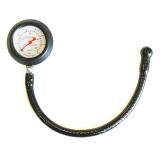 image from advantage-motorsport.co.uk |
Tyre pressure monitoring is commonly used within the road vehicle sector and within the motorsport environment to effectively monitor the vehicle tyre pressures. Tyre Pressure Monitoring Systems (TPMS) were adopted initially in the mid-1980s but they have become more popular within the past decade, with many different manufacturers embracing the technology. As the correct tyre pressure is crucial from both safety and environmental standpoints, fitting Tyre Pressure Monitoring Systems is now being considered as mandatory for all new vehicles.
Indirect types work by
using an existing vehicle sensor, usually that of the ABS (anti-lock brake)
system, to detect low pressures. Unfortunately, indirect Tyre Pressure
Monitoring Systems are often not very accurate and require the driver to reset
the system every time a tyre is inflated.
Direct Tyre Pressure Monitors are more common and effective. They consist of a
combined tyre pressure sensor and valve unit, attached to the inside of each
wheel rim. The sensors emit a low-frequency radio signal to a
receiver, the message from which is sent to the vehicle’s onboard computer. The
driver is then alerted if the tyre pressures fall below the prescribed limits.
As getting power to a rotating wheel is very difficult, most tyre pressure sensors are equipped with an internal battery, which is intended to last approximately ten years. Once it is exhausted, the entire tyre pressure sensor and combined valve must be replaced (motoringassist.com).
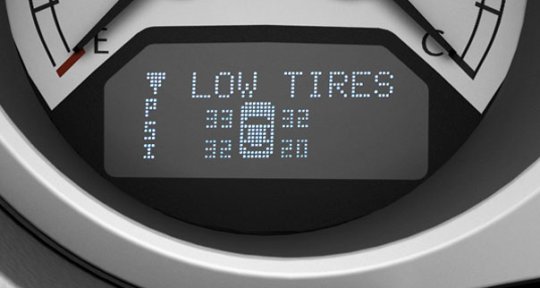 image from greenautoblog.com | 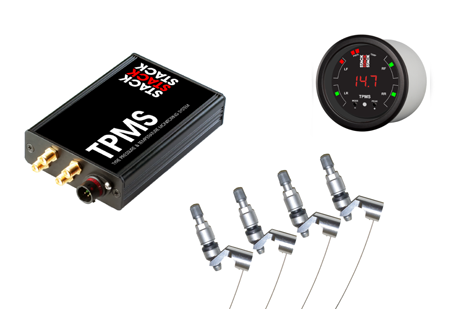 image from stackltd.com |
o Safety
Advance warning of tyre issues (including slow puncture detection) prevents costly accidents and injury.
o Performance
Tyres provide the biggest and “easiest” performance gain. The right pressure and temperature on the warm up lap can give you a performance advantage to make up many places during the first lap.
o Strategy
Data analysis can control tyre wear, allowing a change in driving style to maximise tyre life (stackltd.com)
The Future
For the better part of 100 years cars have run on cushions of pressurised air encased in a hard rubber shell (also known as Pneumatic Tyres). That could all be set to change as we enter a new decade as research and production of an airless tyre is more vigorously pursued.
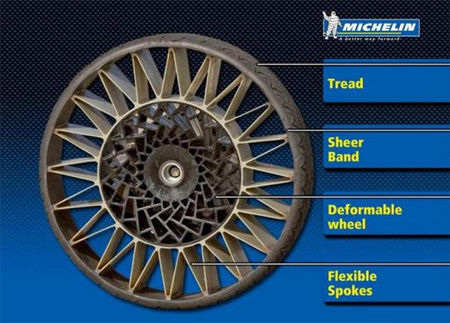
Tyre Recycling
Old tyres are currently used in a wide range of applications. Out of the 50 million used tyres that are currently collected each year under the Tyre Recovery Association's Responsible Recycler Scheme, 34 percent are used in new products, 25 percent are used as energy sources (typically in cement and lime kilns), 6 percent are used in retreading, 10 percent are used in landfill engineering and the remaining 25 percent are reused. Potential uses · Construction bales · Carbon Products · Drainage backfill · Gaskets, hoses, rings, seals · Landfill engineering · Rail Sleepers · Riverbank reinforcement · Expansion joints · Stabilisation · Horse arena ménage · Sound barriers · Retreading · Sports/play surfaces ·
Tyre Derived Fuel (TDF) Flooring materials · Carpet underlay · Rubber modified bitumen for road surfaces · Moulded/ extruded parts · Sheet materials & roofing (tyrerecovery.org.uk) |  image from tyremount.com |
