Greenhous Gases
The warmer temperature of the earth is caused by the earth’s atmosphere and is known as the Greenhous Effect. Without the existence of the atmosphere the earth’s average temperature of 14-15 ⁰c would be closer to -18⁰c. Within environmental areas the term has become more related to the increased Greenhous Effect occurring in the earth’s lower atmosphere, resulting in higher mean temperatures. This is believed to be leading to more unpredictable weather and changes in the climate in various parts of the world.
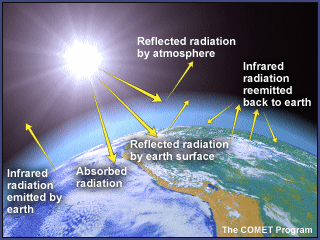
image from http://www.ucar.edu/learn/images/gheffect.gif
Human activities are causing greenhouse gas levels in the atmosphere to increase. This graphic explains how solar energy is absorbed by the earth's surface, causing the earth to warm and to emit infrared radiation. The greenhouse gases then trap the infrared radiation, thus warming the atmosphere (maps.groda.no).
Of the human produced Greenhous Gases the main contributor to the Greenhous Effect is CO₂. The production of CO₂ from industrial activities and other human activities has increased the concentrations of gas in the atmosphere.
CO₂ doesn’t absorb energy from the sun, but it does absorb some of the heat energy released from the earth. When a molecule of carbon dioxide absorbs heat energy, it goes into an excitable unstable state. It can become stable again by releasing the energy it absorbed. Some of the released energy will go back to the earth and some will go into space. In effect carbon dioxide lets the light energy in but doesn’t let all of the heat energy out, similar to a greenhouse. The below graphs show how the CO₂ emissions increase relates to the worldwide temperature increase.
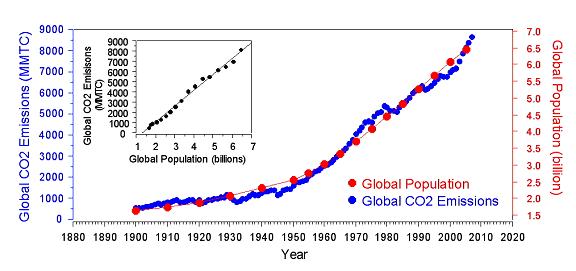
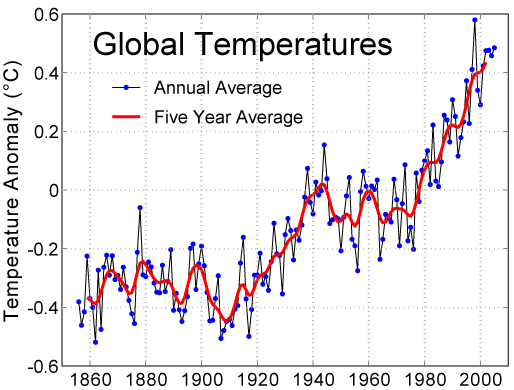
images from cheaperpetrolparty.com
Relating to the Greenhous Effect
is Carbon Footprint. A carbon footprint
is a measure of the impact our activities have on the environment, and in
particular climate change. It relates to the amount of greenhouse gases
produced in our day-to-day lives through burning fossil fuels for electricity,
heating and transportation etc.
The carbon footprint is a measurement of all greenhouse gases we individually
produce and has units of tonnes (or kg) of carbon dioxide equivalent
(carbonfootprint.com).
A carbon footprint is made up of the sum of two parts, the primary footprint and the secondary footprint.
The primary footprint is a measure of our direct emissions of CO2 from the burning of fossil fuels including domestic energy consumption and transportation (e.g. car and plane). We have direct control of these.
The secondary footprint is a measure of the indirect CO2 emissions from the whole lifecycle of products we use - those associated with their manufacture and eventual breakdown. To put it very simply – the more we buy the more emissions will be caused on our behalf.
Carbon footprint calculations follow the methodology outlined in DEFRA's Voluntary Reporting Guidelines, and uses the most up to date emission factors (currently using 2010 Defra / DECC’s Greenhouse Gas Conversion Factors for Company Reporting Methodology). The only exceptions to this are some country specific factors (which are sourced for international sources such as the World Resource Institute’s Greenhouse Gas protocol), and the Individual's Secondary Footprint calculations (which are based on estimates developed by Carbon Footprint Ltd).
The calculations use emissions factors which take account of all greenhouse gases (i.e. CO2, N2O, methane etc.) released by the activities, with the results presented in units of metric tonnes of CO2 equivalent (CO2e). In most cases that means the results will be slightly higher than if calculating CO2 only.
To include all aspects of domestic footprints it is necessary to enter information about your, personal travel and lifestyle over the last 12 months.
