Fuels There are various types of fuel available on the market with differing grades and types emitting varying amounts of CO₂ upon combustion. Petrol
is rated by octane number with the octane rating being a measurement of the
fuel's ability to resist engine knocking. Knock occurs when the fuel-air mix in
the cylinder explodes instead of burning in a controlled way. This shockwave
moves within the combustion chamber, and creates a metallic 'pinging' sound. Octane NumbersUsually, there are three different octane numbers associated with all petrols. Petrol's Research Octane Number (RON) is measured under simple test conditions. Petrol's Motor Octane Number (MON) is measured under tougher test conditions and at higher engine speed and temperature.The average of these two values is what becomes related closer to actual driving conditions. This value is known as the Road Octane Number, and is what should be used in filling stations. 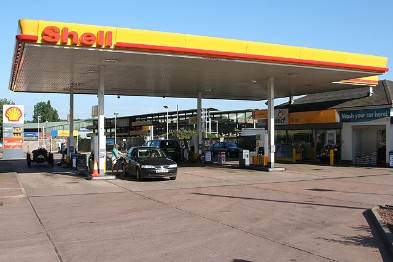 image from geograph.org.uk Fuel Additives LeadGasoline when used in high compression internal combustion engines has a tendancy to autoignite, causing damaging engine knocking. The discovery that lead additives modified this behaviour led to their adoption in the 1920’s allowing more powerful, higher compression engines. Leaded fuel was removed from general sale in 2000 due to the danger of lead to human health. A side effect of the lead additives was protection of the valve seats from erosion. Many classic cars' engines have needed modification to use lead-free fuels since leaded fuels became unavailable. There are three main groups of substances the
oil companies use instead of lead. Dr Michael Dawson explains that when the oil companies removed lead from US gasoline in the 1980s, the increased aromatic content had two deleterious effects: "Firstly, air pollution became worse because aromatic compounds are very photochemically active. Secondly, tailpipe emissions of the carcinogen benzene increased." (Daily Telegraph). The carcinogen benzene is an inexpensive substitute for lead. As an example, in Germany in 1993, 32 million tons of fuel were burnt. Around 10 million tons of aromatics were in this fuel-and at least three-quarters-of-a-million tons would have been benzene. A significant amount of this fuel finds its way into the atmosphere as benzene. The US EPA claims that half of all cancer cases may be related to air pollution. For a lifelong exposure to a microgram of benzene per cubic metre (approx. 1 part per billion), it estimates that 2.8 people per million will be diagnosed with leukaemia. The World Health Organisation comes up with a figure of four leukaemia cases per million, and the German Cancer Research Centre with nine projected cases (coffinman.co.uk). |
 Diesel automatically ignites and burns when it is compressed to a very high pressure. The released energy is contained by the engine and powers the vehicle. The key difference between diesel and petrol engines is auto-ignition. A spark plug ignites the fuel in a petrol engine whereas a diesel engine auto-ignites. Diesel has a Cetane Index and Number rather than the Research Octane Number (RON) that petrol has.  Bio-diesel is a more environmentally friendly fuel slowly becoming available across the UK. It is produced from renewable energy sources such as sugar beet, rape seed and sunflowers and is a biological substitute for regular diesel. Bio-diesel fueled vehicles are more environmentally friendly than conventional cars which run on petrol and diesel because the fuel is not as toxic and does not produce as many damaging exhaust emissions.  Leaded Four Star petrol was removed from sale on British forecourts on 1st January 2000. However, Leaded Four Star is now sold in a small amount of licensed stations in the UK.
Super FuelsMany of the large petrol companies have launched 'super fuels' - petrols and diesels that have a higher research octane level. These fuels are said to increase power in many vehicles, deliver less pollution than regular fuels and help to maintain a cleaner engine. Amongst these 'super fuels' are Tesco's Super Unleaded 99 Octane petrol, supplied by Greenergy, now sold at many stations across the UK and also BP's Ultimate 102 Unleaded which is currently the most advanced, high-performance petrol you can buy on UK forecourts (extracted from petrolprices.com). V-Power Diesel is a blend of regular petroleum-based diesel and synthetic diesel, created using gas to liquids (GTL), along with some extra additives designed to clean the injection system and improve injection pump and injector lubricity. One characteristic of V-Power diesel is that it is a lot clearer and odourless than normal diesel, mainly due to the synthetic GTL component. The fuel is slightly less dense than regular diesel so, per volume, the unit energy is actually lower than regular diesel. This is offset, as the fuel tends to ignite more readily (and thus has a higher cetane rating) than regular diesel, and a side benefit of this is that it tends to produce less soot during combustion. Anecdotal evidence shows that its performance varies depending on how an engine is set up. In most cases, it will make a rough-sounding engine run noticeably smoother, and can also alter the performance characteristics; typically some low-end torque is lost, but performance in the middle of the rev range and above is increased. In some engines however, particularly well-tuned common rail turbodiesels, very little effect can be seen or felt. (Shell.com)Each of the various fuels emit differing levels of CO₂ per litre. This is shown below; Petrol – 2.31kg of CO₂ per litre Diesel – 2.68kg of CO₂ per litre Biodiesel – 0.02kg of CO₂ per litre (people.exeter.ac.uk) Bioethanol – 1.93-2.64kg of CO₂ perlitre(esu.strath.ac.uk) From the results above biodiesel releases far less CO₂ per litre, but this fuel is not currently widely available, along with bioethanol. Petrol then releases less CO₂ than diesel, but diesel engines get better economy than petrol. Therefore the diesel engine will emit more CO₂ per litre than the petrol engine, but the diesel engine will ultimately be able to travel further on the one litre than the petrol engine. Therefore the diesel engine will emit less CO₂ per kilometre than the petrol. |


