Mitsubishi Gdi Gasoline Direct Injection (GDI) Mitsubishi is currently the leader of GDI (Gasoline Direct Injection) technology. It has already applied GDI in different engines, from 1.5-litre four to 4.5-litre V8. Now most of its production engines are GDI-equipped. Mitsubishi claimed GDI consumes 20 to 35% less fuel, generates 20% less CO2 emission and 10% more power than conventional engines. 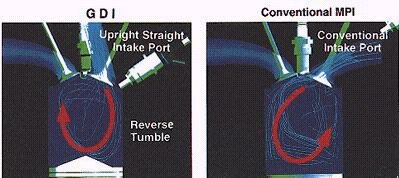 image from autozine.org Mitsubishi GDI engine has an extraordinarily high compression ratio of 12.5 : 1, this is perhaps the highest record for production petrol engine. The result is higher power output. During compression, the heated air is cooled by the fuel spray, thus knocking becomes less easy to occur. One of the few drawbacks of GDI engine is the higher NOx pollutant
level. A newly developed catalytic convertor dealt comfortably with this.
Nevertheless, USA and many developing countries cannot be benefited by it
because their high-sulphur petrol will damage the catalyst (autozine.org). For further reading see http://www.autozine.org/technical_school/engine/petrol1.htm
|
VAG FSi Technology FSI technology makes it possible to achieve a seemingly improbable combination of lower fuel consumption and enhanced power and performance. FSI direct fuel injection technology brings these benefits to virtually all the petrol engines in the Audi range, in many cases in combination with turbo charging for optimum response. More power, less fuelFSI technology increases the torque and output of petrol engines, making them up to 15% more economical and with reduced exhaust emissions. The dimensions and harmonisation of the combustion chamber design, combined with the airflow and injection rate, results in more power being squeezed out of every drop of fuel. 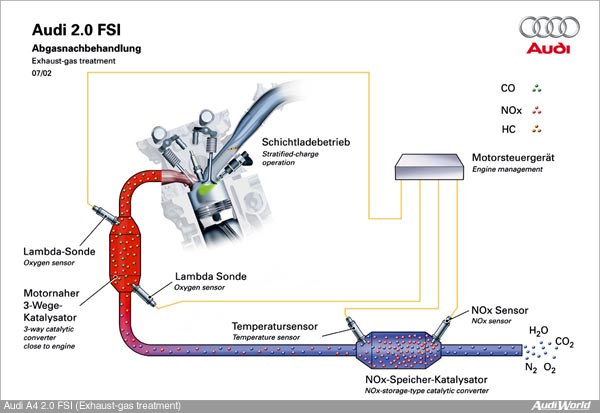 image from audiworld.com For further reading see http://www.audi.co.uk/audi-innovation/our-technologies/fsi-tfsi-and-tdi.html. |
|
Fiat MultiAir Multiair is a brand name for the patented electromechanical actuation of the inlet valve that allows the fuel/air mix into the engine's combustion chamber. The engine block is the same old four-cylinder 1.4-litre Fire (Fully Integrated Robotised Engine) launched in 1985. The clever bit about the Multiair cylinder head system on top is that it removes the direct link between the camshaft and the inlet valves. The single camshaft has three nodes per cylinder; two to actuate the exhaust valves and a single inlet cam which pushes a small pump that either opens the valves hydraulically, or pushes the engine oil into a separate sprung-loaded, high-pressure reservoir. With no conventional throttle butterflies in the inlet manifolds, the engine is relieved of the pumping losses which dog conventional petrol units. Early closing and late opening might sound like a shopping trip in rural Ireland, but in Fiat's case they are used to save fuel in specific driving conditions (telegraph.co.uk). For further reading see |
||
