Materials
Materials are an important aspect of motorsport as the lighter the vehicle the less fuel used to propel the vehicle. Carbon fibre is composed of carbon atoms bonded together to form a long chain. The fibres are extremely strong, stiff and light, and are used in many processes to create excellent building materials. Carbon fibre material comes in a variety of "raw" building-blocks, including yarns, uni-directional, weaves, braids, and several others, which are in turn used to create composite parts. Within each of these categories are many sub-categories of further refinement. For example, different types of carbon fiber weaves result in different properties for the composite part, both in fabrication, as well as final product. In order to create a composite part, the carbon fibers, which are stiff in tension and compression, need a stable matrix to reside in and maintain their shape. Epoxy resin is an excellent plastic with good compressive and shear properties, and is often used to form this matrix, whereby the carbon fibers provide the reinforcement. Since the epoxy is low density, one is able to create a part that is light weight, but very strong. When fabricating a composite part, a multitude of different processes can be utilized, including wet-layup, vacuum bagging, resin transfer, matched tooling, insert molding, pultrusion, and many other methods. In addition, the selection of the resin allows tailoring for specific properties. Pros and ConsCarbon fiber reinforced composites have several highly desirable traits that can be exploited in the design of advanced materials and systems. The two most common uses for carbon fiber are in applications where high strength to weight and high stiffness to weight are desirable. These include aerospace, military structures, robotics, wind turbines, manufacturing fixtures, sports equipment, and many others. High toughness can be accomplished when combined with other materials. Certain applications also exploit carbon fibre's electrical conductivity, as well as high thermal conductivity in the case of specialized carbon fibre. Finally, in addition to the basic mechanical properties, carbon fibre creates a unique and beautiful surface finish. Although carbon fibre has many significant benefits over other materials, there are also tradeoffs. First, solid carbon fiber will not yield. Under load carbon fiber bends but will not remain permanently deformed. Instead, once the ultimate strength of the material is exceeded, carbon fiber will fail suddenly and catastrophically. In the design process it is critical that the engineer understands and accounts for this behavior, particularly in terms of design safety factors. Carbon fibre composites are also significantly more expensive than traditional materials. (dragonplate.com) Carbon Fibre Chassis The main component part of an F1 car is the chassis, or carbon fibre composite tub (sometimes referred to as a survival cell). Before being brought to the assembly area, a composite tub will have passed through the composite manufacturing department, where it was made, cured in an autoclave, trimmed, and cleaned. In addition, the various mounting holes will have been precision drilled and tapped. In the assembly area the tub will be placed on an assembly jig. These jigs, or fixtures, will locate the tub precisely to facilitate accurate measurements during the assembly process. This is now filtering down into road cars with vehicles such as the McLaren MP4-12C having a carbon fibre chassis. Carbon Fibre vs. MetalsWhen designing composite parts, one cannot simply compare properties of carbon fibre versus steel, aluminum, or plastic, since these materials are in general homogeneous (properties are the same at all points in the part), and have isotropic properties throughout (properties are the same along all axes). By comparison, in a carbon fiber part the strength resides along the axis of the fibres, and thus fibre properties and orientation greatly impact mechanical properties. Carbon fibre parts are in general neither homogeneous nor isotropic. The properties of a carbon fibre part are close to that of steel and the weight is close to that of plastic. Thus the strength to weight ratio (as well as stiffness to weight ratio) of a carbon fibre part is much higher than either steel or plastic. (dragonplate.com) Space Frame Chassis For higher strength required by high performance sports cars, tubular space frame chassis usually incorporate a strong structure under both doors, hence result in unusually high door sill and difficult access to the cabin. In the early 50s, Mercedes-Benz created a racing car 300SLR using tubular space frame. This also brought the world the first tubular space frame road car, 300SL Gullwing. Since the sill dramatically reduced the accessibility of carbin, Mercedes had to extend the doors to the roof so that created the "Gullwings". Since
the mid 60s, many high-end sports cars also adopted tubular space frame to
enhance the rigidity / weight ratio. However, many of them actually used space
frames for the front and rear structure and made the cabin out of monocoque to
cut cost.
(autozine.org) Alloys AMC225xe is a high quality aerospace grade aluminium alloy (AA2124) reinforced with 25% by volume of ultrafine particles of silicon carbide. It is manufactured by a special powder metallurgy route using a proprietary high-energy mixing process which en-sures excellent particle distribution and enhances mechanical properties. The key benefits of AMC225xe for structural applications include: •Weight saving •Increased component stiffness •High fatigue resistance. The combination of properties achieved with AMC225xe provides the potential for outstanding structural performance in a wide range of markets and applications including: Motorsport •Performance valve train •Cylinder liners •Pistons •Connecting rods •Brake callipers •Disk Bells | 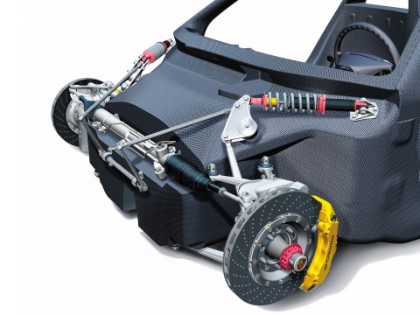 image from seriouswheels.com 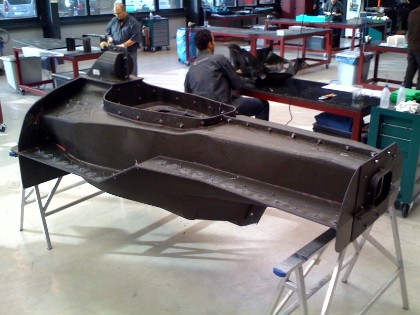 image from michaeloliveronline.com 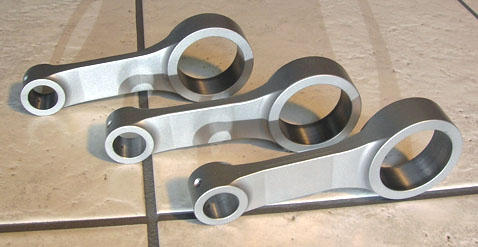 image from amc-mmc.com 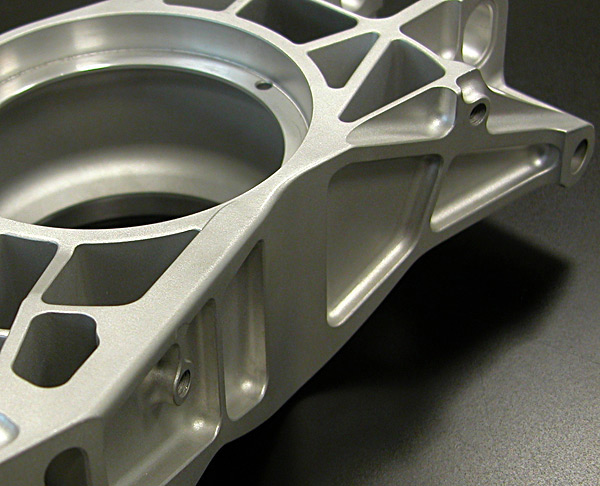 image from crptechnology.com  image from carbonelite.com 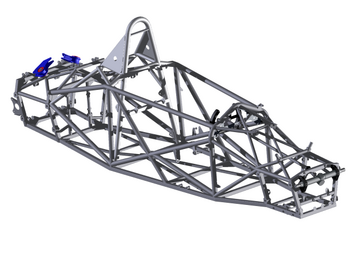 image from wordpress.com Drag and Downforce Along with vehicles attempting to become lighter to increase fuel efficiency it is also necessary to overcome drag. A vehicle which produces lesser aerodynamic drag is more fuel-efficient as it requires lesser power to accelerate it. This is because the lesser the aerodynamics, the more resistance is put on the vehicle due to the wind; causing the engine to work harder making the pistons go faster burning more gas/oil. Aerodynamics play a more important role as the speed of the vehicle increases as the drag in directly proportional to the square of the vehicle's velocity. Within motorsport teams try to run vehicles with increased downforce. This aerodynamic force pushes the vehicle into the ground from differences in air pressure. With increased downforce comes increased drag as the 'footprint' of the vehicle is heavier at speed, Formula One cars can weigh five times as much at maximum speed from downforce. Depending on race events depends on setup for the aerodynamics of the vehicle. With endurance racing decreased drag can bring increased fuel efficiency. This can alter the number of pit stops required and ultimately assist the vehicle and team to win the race. |
