Engine and Powertrain Development The development of the internal combustion engine over the last 150 years led to the motorcar becoming widely available and therefore a well used form of transport. It is, however, a piece of technology that can be extremely damaging to the environment. From the energy and raw materials used in its production, to the oil and petrol consumed by the engine during its lifetime; its use is damaging. Development of Internal Combustion engine technology is one method of reducing the impact of Internal Combustion engines; another method is the introduction of new technologies such as electric motors and hydrogen fuel cells. Lean Burn refers to the use of ‘lean’ mixtures in an internal combustion engine. The mixture has considerably less fuel in comparison to the Stochiometric combustion ratio, generally as high as 65:1 (Air: Fuel ratio) as opposed to 14.7:1 for petrol. Lean burn mode is used to, ‘reduce CO emissions efficiently use of more fuel-efficient engines, such as lean-burn engines, which potentially offer greater fuel efficiency, may gain importance. Operating an engine with lean-of-stoichiometric requires burning of fuel in an excess of oxygen and this can provide fuel consumption improvements of at least 10%, in addition to substantial reductions in CO and NOx emissions. Since a lean-burn engine operates close to the limits of combustion, its efficient functioning demands good mixture preparation, a very high energy spark to ignite the weak mixture and very good monitoring of combustion quality and mixture strength through a closed-loop control system.’ Many of these concepts are incorporated into recent Japanese designed engines, namely Honda’s VTEC-E and Toyota’s Carina-E. These engines can typically run at A/F ratios of 22:1, meet European and US emission regulations and offer fuel consumption improvements of up to 25% under cruising conditions (what-when-how.com). The three-way catalyst is used in rich-burn or stoichiometric engines for simultaneous conversion of oxides of nitrogen (NOx), carbon monoxide (CO), hydrocarbons (HC), formaldehyde (CH2O) and EPA classified Hazardous Air Pollutants (HAPs). The three-way catalyst is effective in a wide variety of engine applications and fuels, including natural gas, propane and gasoline. A closed loop air-fuel ratio controller is required for the three-way catalyst to work effectively (dcl-inc.com). 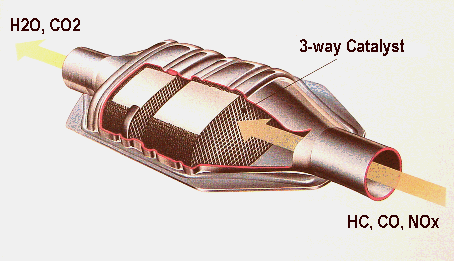 image from aa1car.com It can be seen that the
exhaust gases coming in and out of the catalyst have Oxygen present. This
creates a problem for our engine management system and is one of the
shortcomings of the three-way catalyst. 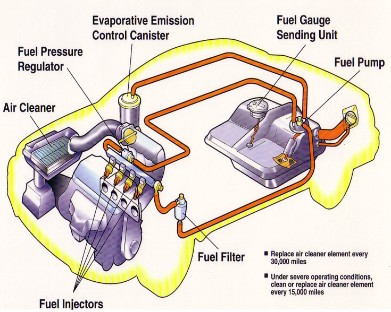 image from gdabob.com HCCI—Homogeneous Charge Compression Ignition HCCI—Homogeneous Charge Compression Ignition—relies upon a very lean (high proportion of air to fuel) and well-mixed (Homogeneous) air-fuel mixture (Charge) that is compressed (Compression) until it autoignites (Ignition). (The HCCI approach is also called Controlled Auto-Ignition: CAI.) The resulting spontaneous burn produces a flameless energy release in a large zone almost simultaneously—very different than the spark/gasoline burn or the compression/diesel burn. HCCI combustion can deliver a very efficient engine, potentially providing a 20% to 30% boost in gasoline engine efficiency without the nasty NOx or PM emissions of a diesel. Theoretically it can operate using a variety of fuels: gasoline, diesel, natural gas, biofuels, or hydrogen. Used in a hybrid application, the more efficient engine would increase the overall fuel efficiency of the powertrain (greencarcongress.com) |
Fuel Injection vs Carbs The function of a carburettor is to mix just the right amount of fuel with air so that the engine runs correctly. If there is not enough fuel mixed with the air, the engine runs lean and either will not run or potentially damages the engine. If there is too much fuel mixed with the air, the engine runs rich and either will not run (it floods), runs very smoky, runs poorly (bogs down, stalls easily), or at the very least wastes fuel. The carburettor controls this mixture, getting the ratio just right. 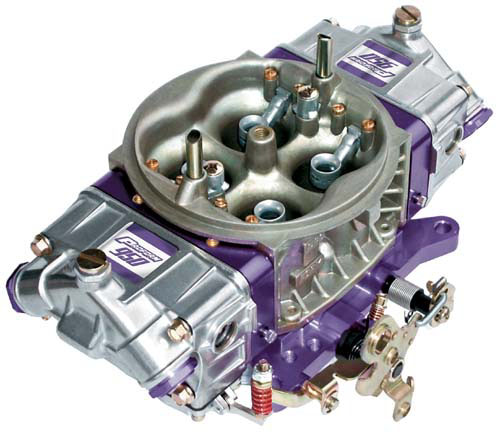 image from realitypod.com When the accelerator is depressed, the throttle valve opens up more, letting in more air. The engine control unit (ECU) sees the throttle valve open and increases the fuel rate in anticipation of more air entering the engine. It is important to increase the fuel rate as soon as the throttle valve opens; otherwise there may be a hesitation as some air reaches the cylinders without enough fuel in it. Sensors monitor the mass of air entering the engine, as well as the amount of oxygen in the exhaust. The ECU uses this information to fine-tune the fuel delivery so that the air-to-fuel ratio is just right. 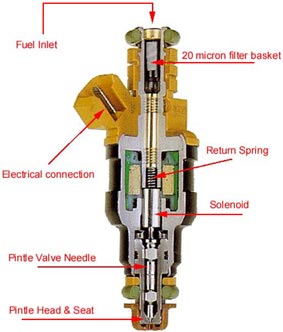 image from autotipsblog.com Carbs Advantages: · Cheap, simple to understand and light! (race use) · Easy to swap some jets to change fuelling characteristics · No electrics or battery required. (Some race vehicles have none or only small battery because of weight considerations) · Work well in most situations · Can be swapped from one engine/car to another pretty easily · More instant throttle response is possible than with Fuel Injection as we don't have to wait for sensors to tell a computer what's happening and wait for it to calculate a result! Disadvantages: · They can ice up in cool damp weather! · They do not have as accurate control of fuel / air mixture as modern fuel injection so can easily kill catalytic Converters... · Fuel can vaporise or boil in summer making hot restarts difficult. · The essential for fuel draw "venturi" always restricts airflow slightly reducing max possible power · Fuel drop out occurs in the manifolds causing higher emissions and fuel mixture dependent on manifold temperature. Fuel sat in the manifold as condensed droplets goes through the engine largely untouched! Fuel Injection Advantages: · Better mixture control. · No choke required for cold starts. · Reliability. · Less ‘flat spots’ than carb systems · Higher peak power possible due to no restriction caused by carb venturi. · Mapped optimisation of fuel delivery requirements. · Offers closed loop electronic control. Disadvantages · Complexity and higher cost. · Electrical power required. · Increased noise. |
|
