KERS - Kinetic Energy Recovery System
The mechanical KERS system utilises flywheel technology developed by Flybrid Systems to recover and store a moving vehicle’s kinetic energy which is otherwise wasted when the vehicle is decelerated. The energy is received from the driveline through the Torotrak CVT, engineered and supplied by Xtrac, as the vehicle decelerates, and is subsequently released back into the driveline, again through the CVT, as the vehicle accelerates.
(f1fanatic.co.uk)
First Generation
The original Flybrid Kinetic Energy Recovery System (KERS) was a small and light device designed to meet the FIA regulations for the 2009 Formula One season.
The key system features were:
- A flywheel made of steel and carbon fibre that rotated at over 60,000 RPM inside an evacuated chamber
- The flywheel casing featured containment to avoid the escape of any debris in the unlikely event of a flywheel failure
- The flywheel was connected to the transmission of the car on the output side of the gearbox via several fixed ratios, a clutch and the CVT (constant velocity transmission).
- 60 kW power transmission in either storage or recovery
- 400 kJ of usable storage (after accounting for internal losses)
- A total system weight of 25 kg
- A total packaging volume of 13 litres
The layout of the device was tailored exactly to meet the customer's
requirement resulting in a truly bespoke solution that fitted within the tight
packaging constraints of a F1 car.
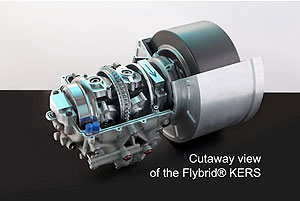 image from torotrack.com |
Second Generation
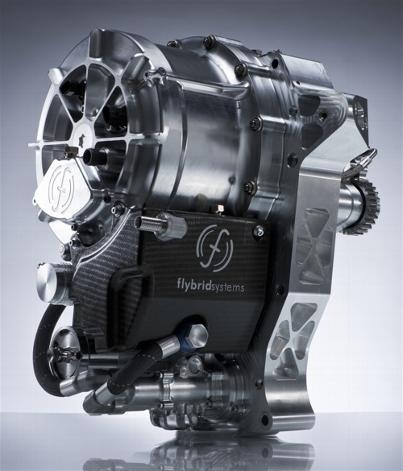
The Flybrid® CFT KERS is a new high-speed flywheel based Kinetic Energy Recovery System for racing car and mainstream automotive application. This is the first true 2nd generation KERS to come to market and represents a step change in size, weight and cost for this green technology of the future.
A complete Flybrid CFT KERS for Formula One capable of 60 kW and 400 kJ per lap weighs less than 18 kg and a plan view section fits on an A4 piece of paper.
The CFT KERS is suitable for both racing and road car application and scales down well to small power outputs and small storage quantities such as would be required for a B class car. Most importantly the CFT KERS promises to be very low cost in mass production and could open up a whole new market for small, ultra efficient yet low cost hybrid cars. (cftkers.com).
 | image from CFTkers.com |
Some have questioned the safety of KERS after two separate incidents. Red Bull Racing were forced to evacuate their factory when a fire alarm was activated after a battery experiment went wrong. A few days later a BMW-Sauber mechanic was given an electric shock during a test session after he touched one of the cars which had been fitted with a KERS device. The mechanic suffered an electric shock after touching the sidepod and steering wheel of the car. There was a high frequency AC voltage between these contact points, the cause of which has been traced back to the KERS control unit and a sporadic capacitive coupling from the high-voltage network to the 12-volt network. The voltage ran through the wiring of the 12-volt network to the steering wheel and through the carbon chassis back to the control unit.
