Hybrid-electric vehicles (HEVs) combine the benefits of gasoline engines and electric motors and can be configured to obtain different objectives, such as improved fuel economy, increased power, or additional auxiliary power for electronic devices and power tools.
Some of the advanced technologies typically used by hybrids include
· Regenerative Braking. The electric motor applies resistance to the drivetrain causing the wheels to slow down. In return, the energy from the wheels turns the motor, which functions as a generator, converting energy normally wasted during coasting and braking into electricity, which is stored in a battery until needed by the electric motor.
· Electric Motor Drive/Assist. The electric motor provides additional power to assist the engine in accelerating, passing, or hill climbing. This allows a smaller, more efficient engine to be used. In some vehicles, the motor alone provides power for low-speed driving conditions where internal combustion engines are least efficient.
· Automatic Start/Shutoff. Automatically shuts off the engine when the vehicle comes to a stop and restarts it when the accelerator is pressed. This prevents wasted energy from idling.
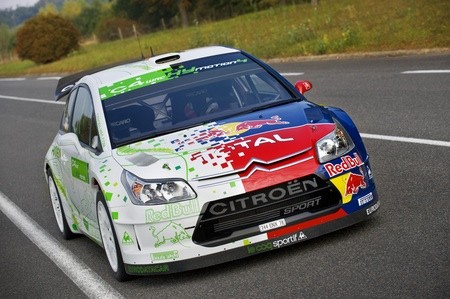
The 2008 Paris Motor Show saw Citroën take
the wraps off its C4 WRC HYmotion4 concept car, the first WRC car to be
equipped with a hybrid energy recovery system which delivers added performance
and lower emissions.
This new concept car – which sports a split livery, with the team's familiar
World Rally Championship colours on one side, and a design based on a more
restful colour scheme redolent of natural materials on the other – illustrates
Citroën's stand on environmental matters, including in the world of motor sport
which stands out as a source of performance-related, reliable and rational
technological innovations.
The HYmotion4 system enables a proportion of the kinetic energy produced during
braking to be recovered and stored. This energy is accumulated by a
motor-generator in the form of electricity in battery packs positioned at the
rear of the car. It can then be employed either to deliver extra power when
accelerating or to drive the car using emission-free electrical power alone,
with no engine noise or exhaust fumes.
These real performance gains have been
achieved thanks to the innovative technological solutions which have been
developed to transform the C4 WRC into the C4 WRC HYmotion4. The system
comprises four key components:
A 125kW electric motor-generator connected to the rear differential (gear
driven),
A pack of 990-cell lithium-ion batteries which deliver a voltage of 400V.
Positioned over the fuel tank.
Two additional cooling systems for the motor-generator and batteries, with a
specific radiator positioned under the right-hand side of the floor.
An electronic control unit to manage the system's power electronics circuit.
The driver is free to select one of the four running modes using the HYmotion4
pre-selection rotary control:
Internal combustion engine mode: the most frequently-used mode for the C4 WRC
(used on stages and potentially on road sections).
Internal combustion engine mode with energy recovery: activated on stages;
improves the brakes' resistance to fade and charges the batteries.
Electric motor mode with energy recovery: used on road sections (untimed), in
built-up areas or in the service park; contributes to increasing the car's
range, reduces noise in built-up areas, and permits the internal combustion
engine not to be used when it is not indispensable.
Boost mode (internal combustion engine and electric modes combined): can be selected
at the desired moment on a stage to benefit from an additional 300Nm-1 of
torque for a limited time.
This performance gain makes optimising energy management a new parameter for
rally drivers to master.
C4 WRC HYmotion4 fits perfectly with Citroën's long-term commitment to motor
sport and its consequential environmental policy. This concept underpins the
brand's policy to conceive very high performance cars which respect the
environment and is the first step prior to other developments which will be guided by future evolutions to the FIA regulations.
(autoblog.com).