There are various electric cars currently on the market, such as the G-Wiz and Mitsubishi 'I'. These vehicles are not designed for performance but for intercity commuting within a short range. Tesla aim to change this view of electric cars with the production of performance vehicles such as the Tesla Roadster. Introduction of vehicles such as these show the possible progression towards full performance electric motorsport. | image from electriccarsite.co.uk 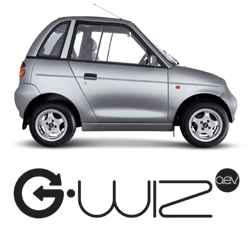 |
Tesla Roadster The Roadster is powered by a 3-Phase Alternating Current Induction Motor. Small, but strong, the motor weighs just over 115 pounds. 375 volts push up to 900 Amps of current into the motor to create magnetic fields. It delivers 288 peak horsepower and 295 lbs-ft of torque at the driver's command. At top speed, the motor is spinning at 14,000 revolutions per minute. The motor is directly coupled to a single speed gearbox, above the rear axle. The simplicity of a single gear ratio reduces weight and eliminates the need for complicated shifting and clutch work. The elegant motor does not need a complicated reverse gear - the motor simply spins in the opposite direction. The battery pack in the Tesla Roadster is the result of innovative systems engineering and 20 years of advances in Lithium-ion battery technology. The ingenious pack architecture enables world-class acceleration, safety, range, and reliability. The pack contains 6,831 lithium ion cells and is the most energy dense pack in the industry, storing 56 kWh of energy. The Roadster battery charger is located on-board the car. This means the Roadster can be plugged into any outlet, anywhere in the world - plug in a cell phone, plug in a Roadster. Charge times vary based on the outlet voltage and Amperage. With the Tesla High Power Wall Connector, a Roadster charges in as little as 4 hours from empty, yet most Roadster owners simply “top off” after each trip and start each day with a full charge. Roadsters are engineered to charge from nearly any 120-volt or 240-volt outlet. Most Roadster owners find they rarely use a complete charge, and charging each night means their car is ready to drive 245 miles each morning. 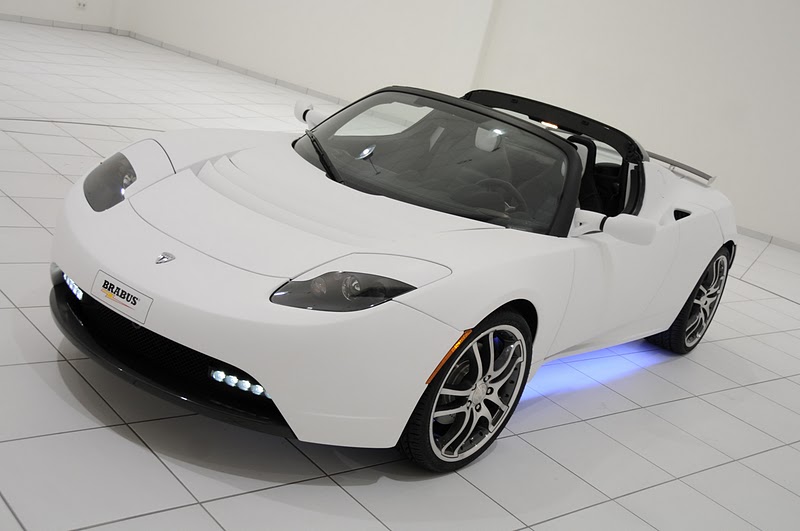 image from luxurycarwallpapers.com The Power Electronics Module functions as a bridge
between the charge port, battery, and motor. It manages and converts
current during driving and charging. As Alternating Current flows into
the car from the wall, the Power Electronics Module converts it to Direct
Current for storage in the battery. When driving, the Power Electronics Module
converts DC back to AC that the motor uses to generate torque. Every electron
ever used in a Roadster, from the motor drive to the dome light, flows through
the Power Electronics Module. At many operating points, it is 97-98% efficient:
less than 2% of converted energy is lost. The regenerative braking system, completely independent of the brake pedal and brakes, is controlled by the Power Electronics Module. The drive experience is similar to engine braking or downshifting in a gas-powered car. The electric drivetrain instantaneously switches from “drive mode” (forward torque) to “generating mode” (reverse torque) based on the throttle position. When the Roadster was first in development, test drivers worked with the firmware team to fine tune the amount of regenerative braking to optimize both vehicle stability and range. Much higher regenerative torque levels are possible, but could result in loss of traction and a less manageable sports car. Alternatively, less regenerative braking returns less energy back to the battery during stop and go driving, resulting in decreased driving range and overall efficiency. The advantageous strength to weight ratio of carbon fibre means using about 30% less material (by mass) than steel to build a light, strong, and safe body. While some other premium sports cars flaunt carbon fibre body panels, none can be purchased for the price of a Roadster.The body styling is based on that of the Lotus Elise. (teslamotors.com) 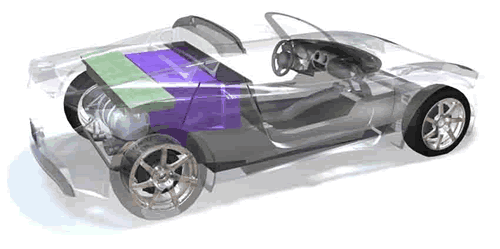 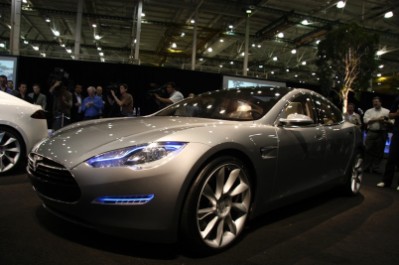 With production of the Roadster grinding to a halt in the next month, Tesla is soon to become a company without a car. But all that will change in mid-2012 when the Model S arrives. Rather than three levels of performance, three models with either a 160, 230 or 300-mile range will be offered. According to Tesla a charge from 10 to 90 per cent of the lithium-ion battery's full capacity will take as little as 45 minutes, using a special 480v supply which can be fitted at customer's homes.The plan with the Model S is to move away from the Roadster's low-volume, high-price philosophy. Tesla aims to sell 20,000 examples of the Model S each year, built in Fremont California, and prices will start from a fraction under 50,000 US Dollars (£32,000) for the 160-mile base model. Read more:http://www.autoexpress.co.uk/news/autoexpressnews/270922/tesla_model_s_spied.html#ixzz1UR0z96Nn |
