Introduction From the early days of motorsport, developments have been made over the decades to turn motorsport into a multi-billion pound business, as well as an international sport. As with all businesses, current affairs and public opinion play a large role in how the business conducts itself. Global warming has become a major worldwide issue over recent years, with the suggestion that the build up of carbon dioxide and other gases being responsible for the average surface temperature to steadily increase. Our use of fossil fuels also means that reserves of items such as coal, natural gas and crude oil will eventually diminish so renewable sources need to be found (globalissues.org). What is EEMS? The concept of Energy Efficient Motorsport (EEMS) has been discussed within the UK motorsport industry for a number of years. It seeks to place a premium on the efficient use of resources and to encourage the development of alternative fuels and power train technologies and put energy efficiency at the heart of modern motorsport – without comprising the sporting spectacle. There is a widely held belief that energy efficiency and green technology are not compatible with exciting motorsport. This is not the case – in fact the UK motorsport industry stands to benefit considerably by adopting EEMS concepts and taking a leading global role. For EEMS to become a reality, UK motorsport and its suppliers, the automotive industry and its suppliers, fuel companies and the government need to agree on one common vision and goal. This vision needs to embrace alternative fuels and technologies to provide manufacturers with solutions to meet increased fuel efficiency targets.  In 2002 the Motorsport Industry Association (MIA), sponsored by the UK motorsport industry, the UK Department of Trade & Industry (DTI) and the Regional Development Agencies (RDAs) in the UK’s Motorsport Valley, published a feasibility study that gathered together some of the best thinking on EEMS. This document explained why it is important that the UK motorsport industry embraces the concept of EEMS if it is to remain relevant to the future of the larger automotive industry. Included in the report were proposals that considered how EEMS concepts might be adopted for competition. M DUK, established at the end of 2003, is comprised of influential figures drawn from across the industry. A £16 million allocation of Government funding was made available to establish and finance projects designed to develop and enhance the UK motorsport industry. The EEMS project now falls under the control of the MDUK and has received funding from the overall allocation (topgear.co.uk).  image from techepics.com |
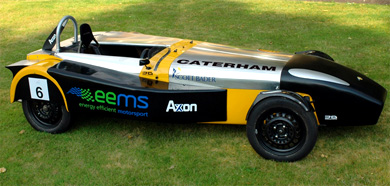 EEMS targets It is the vision of the Project Team that by 2010 EEMS will be a major feature of UK motorsport and the concept will have been exported to other countries. Targets include the following: -At least one high profile UK championship to be running to fuel flow based engine regulations, which will allow considerable technical freedom for engineers to develop race winning fuel efficient and environmentally friendly technologies. -OEM’s from around the world to be working in partnership with UK motorsport companies to compete in championships based on EEMS concepts.  The adoption of technical regulations that place energy efficiency and the development of alternative fuels and engine technologies at the heart of motorsports competition is not really a leap into the unknown or a major philosophical change. Neither does this imply that the essence of exciting high-speed competition will be removed from the sport. Instead these advances will provide a high profile and exciting marketing and technology platform that showcases the latest green technology (topgear.co.uk).
EEMS achievements These are early days, but already motor racing seems to be accepting that its future lies in energy efficiency. An Aston Martin fuelled by bio-ethanol is competing in the British GT Championship. And cars running on alternative energy are now in the Le Mans 24-Hour challenge. Even Formula One (F1), most of whose teams are UK-based, is now using KERS which harness the massive braking power of its race cars and utilise it to drive the engines. Also UK-based transmission supplier Xtrac helped Audi develop its ground-breaking diesel-powered R10 racing car: now this technology is being transferred to Audi’s road cars (ukti.gov.uk). |
|||
